What Is High-Functioning Depression?
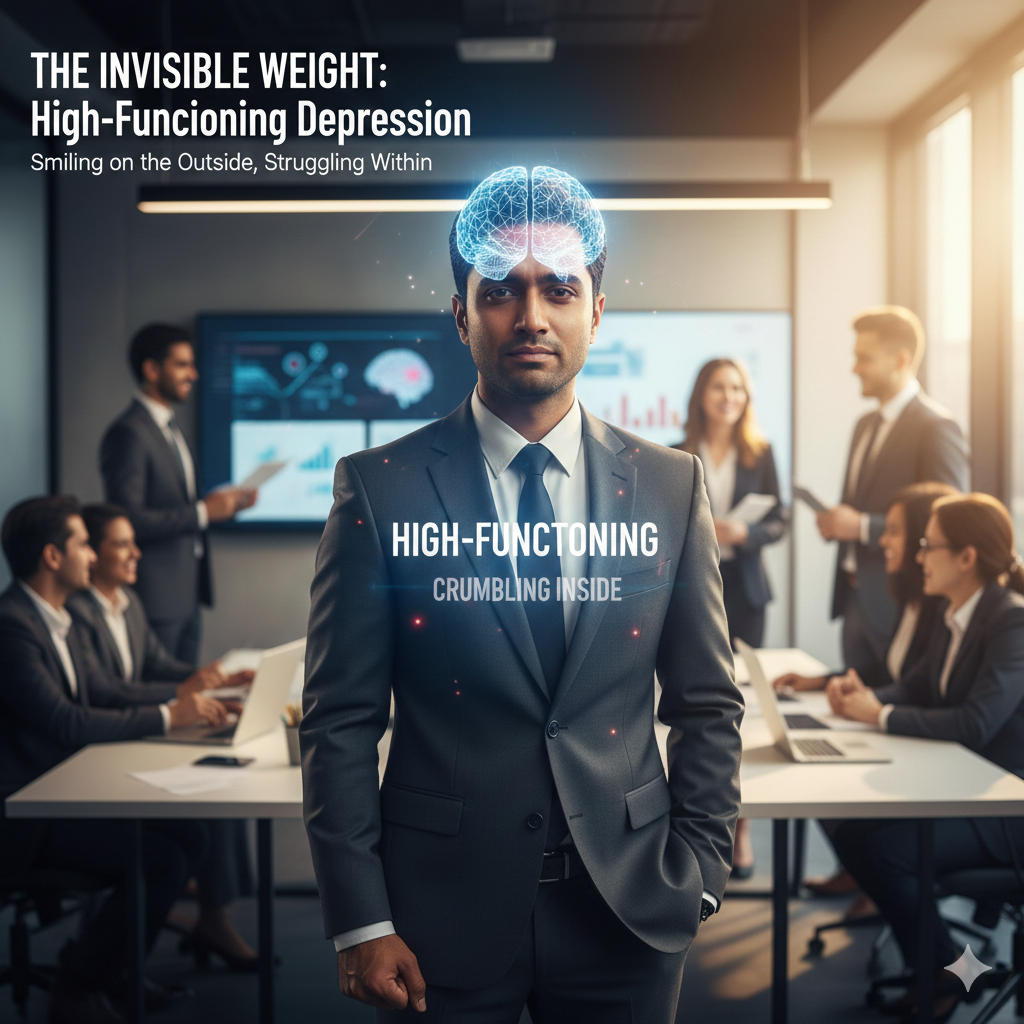
High-functioning depression is a type of chronic, mainly mild-to-moderate depressive disorder of mental health function wherein individuals continue to carry out their work and life commitments but ruminate over the emotional and cognitive pain. Such individuals may be considered as efficient, productive, and mentally/emotionally strong from the outside; however, they are simultaneously concealing from other people a state of depression, absence of energy, and overall bad health.
Core Behavioral and Emotional Signs
1. Persistent Low Mood Behind Competence
People in positions of power frequently portray a refined image of themselves at work but admit to feeling numb, empty, or having an emotionally “blunted” range inside.
2. Fatigue and Decreased Drive
They get the work done, but it is obvious that it takes them considerably more strength. There is a great number of people who counterbalance this by working late into the night, thus covering up the emotional burden with their productivity.
3. Loss of Interest (Anhedonia)
They keep doing the activities—meetings, hobbies, and routines—that they had before, but now these things give them less pleasure or fulfillment.
4. Sleep and Appetite Dysregulation
Long-term insomnia, oversleeping, loss of appetite, or eating for comfort may become your habits even if they are only caused by stress.
5. Cognitive Fog and Slower Decision-Making
Poor concentration, inability to prioritize tasks, and slow coming up with of ideas influence one’s daily performance, but people usually refer to these as “work pressure”.
6. Perfectionism and Self-Criticism
On the inside that person battles self-doubt, overthinks, and is afraid of not being able to meet the expectations; however, the high-achieving facade is still there.
7. Social Withdrawal Outside Work
Though socially functional during interactions at the workplace, they limit the extent of engagement with the other people on a personal level, giving reasons such as tiredness and lack of time.
8. Minimising Symptoms
They are very much inclined to underestimate their emotional state, uttering words like “I’m fine” or “It’s just work,” thereby putting off the act of seeking help and hiding the seriousness.
Insight
Presenteeism carries a heavier weight than absenteeism in depression-related work loss:
Presenteeism (employees working while mentally unwell) is responsible for 60–75% of the productivity loss associated with depression and this has been confirmed by various studies. In other words, the figures cited in these studies point out that most of the loss in productivity due to depression is the result of employees who choose to come to work even though they are not mentally well and not due to the employees taking sick leaves. Hence, the reason why high-functioning depression is often still unnoticed but it is very expensive in
Data Points to Strengthen Your Assessment Answer
● Persistent depressive disorders are often mirrored in high-functioning depression patterns and are responsible for about 1.5% of U.S. adults annually and around 2.5% across a lifetime, which indicates that a large number of people suffer from chronic low-grade depression.
● Around 15% of adults of working age worldwide are reported to have a mental health condition, based on WHO estimates.
● Depression and anxiety, combined, are the main causes of lost productivity worth approximately US$1 trillion per year, which is equivalent to 12 billion workdays lost globally. This, in turn, shows that “functioning” workers can still be under substantial internal pressure that affects their output in the long run.
Impact/Implications for Workplaces
1. Productivity Erosion, Not Collapse
Since the professionals keep up their external appearance of being competent, organizations are quite often blind to these subtle dips: slower turnaround, lessened creativity, or increased reliance on routine tasks.
2. Higher Burnout and Turnover Risk
If left without intervention, chronic depression may only be the beginning of a major depressive episode, a longer period of absence from work, or sudden disengagement.
3. Leadership Blind Spots
Managers may interpret the symptoms as lack of interest, attitude issues, or poor time management and therefore fail to recognize the mental health problem.
4. Team-Level Ripple Effects
Decreased enthusiasm together with emotional distancing and energy levels that go up and down can negatively influence the team’s cooperation, morale, and ways of communication.
5. Health and Financial Costs
The organizations’ costs that will be manifested in the long run are absenteeism, presenteeism, higher insurance utilization, and lower retention.
Forward Look
The increasing acknowledgment of high-functioning depression is indicative of a change in the way companies have to redefine health—not only by the outward performance but also by the sustainable mental health of the employees. Innovative teams have the possibility to combine the measures of early screening, providing support in a stigma-free manner, manager training, and flexible wellbeing initiatives for the detection of the invisible emotional strain. When workplaces are psychologically more informed, they see the identification of high-functioning depression as a prevention measure and a key element of their endurance in the long run.
Summary
Often, high-functioning depression can be misleading as it is masked by traits like competence, consistency, and good results. The intention of this write-up is to help people realize that, instead of focusing solely on the visible performance, they should consider the invisible stress – for, ultimately, mental health over a long period should not be sacrificed for a continuous productivity.